The Best AI Visibility Tools, Ranked by What They Actually Do
Most AI visibility tools show you where ChatGPT, Gemini, Claude, Perplexity and Google's AI mention your business. Fewer of them change it. Here are the leading tools compared by what they measure, what they do on their own, what they cost and who they are for.

An AI visibility tool tells you how often ChatGPT, Gemini, Claude, Perplexity and Google's AI Overviews name your business when people ask about what you sell. That is useful, but it is only half the job. The other half is changing the answer.
That is harder than it sounds, because AI does not build its answer from your website alone. It also reads your social media, your Google profile, your reviews, directories, forums and articles that compare you with competitors. A tool that only watches, or works on only one of those places, can move only part of the answer.
- Best for small businesses, lean teams and agencies that want the work done: SMARTYPANT AI. Agents that handle GEO and SEO, website content, social media, Google Business Profile and review replies, and measure the result weekly on five AI platforms.
- Best for brands with many locations: SOCi or Uberall.
- Best for enterprise analytics: Profound, with more than 1,000 enterprise brands as customers.
- Best tracker for marketing teams: Peec AI.
Disclosure: SMARTYPANT AI is our product. We rank it first on a criterion we explain and back with data below, and we say where other tools are the better choice.
Where AI gets its answers about a business
In our field report CITED, we describe a business's presence as five layers. AI can draw on any of them:
- Owned: your website.
- Structured: schema markup and verified profiles that tie your website, listings and social accounts together as one business.
- Corroborating: independent sources that confirm what you say, such as directories, review platforms, your Google Business Profile and LinkedIn.
- Discussion: places where people talk about you or your category, such as social media, YouTube, Reddit and forums.
- Comparative: "best of" lists, "X vs Y" articles and "alternatives to" pages. You are reading one.
Customers check a business in several of these places before choosing it, as we showed in The Decision Happens Before the Click. The 2026 data shows that AI does the same.
Even a search for your own name starts with an AI summary
Ahrefs analysed 232.8 million US Google results from July to September 2026. On searches for a brand's name, AI Overviews appeared on 61.3% of results in July and 73.3% in September, reaching 82.91% on 29 September. They largely take the top spot, above the brand's own website. Their most cited sources were Wikipedia, YouTube, LinkedIn and Facebook, not the brand's site.
Each AI platform reads different places, and they keep changing
Meltwater counted about 7.3 million citations on eight AI platforms, including Claude, in August 2026. YouTube was the most cited source, followed by Reddit and LinkedIn.
Each platform behaves differently. In the same data, ChatGPT cited none of the five social platforms in Meltwater's table, while Perplexity cited LinkedIn 69,302 times. And the sources shift without warning: Goodie counted 16 changes in how AI platforms chose their social sources in seven months, none of them announced. In August alone, ChatGPT's share of citations going to Reddit fell from 8.0% to 2.9%, and Gemini started citing Facebook.
Google reads your posts, ChatGPT reads your profile
BrightEdge found 19.5 million Google AI Overviews citing Facebook in about 300 million US searches. Its August 2026 study showed which part of a social presence gets cited. Google's AI Overviews mostly cite posts: Reels made up 89% of the Instagram citations. ChatGPT mostly cites profiles: company and jobs pages made up about 80% of its LinkedIn citations, and profile pages 42% of its Instagram citations.
Google's AI mostly reads your posts. ChatGPT mostly reads your profile. A tool that only works on your website reaches neither.
How we ranked the tools
Our main question: on how many of these layers does the tool do the work itself, instead of only measuring? Where two tools did a similar amount of work, we looked at how deeply they measure, and then at price and public proof.
Because almost every tool now calls itself an "agent", we used a simple test. A tool does the work itself when it:
- plans recurring marketing work without being asked each time,
- creates finished assets, not just ideas or briefs,
- publishes them,
- keeps going week after week, and
- uses the results to decide what to do next.
Human approval can stay in the loop. What matters is that the work gets done, not just suggested. Working on a layer does not mean controlling it: no tool can write a Reddit thread or a journalist's article for you, and none should. Prices and features are as published in October 2026.
All tools at a glance
| Tool | Best for | Measures AI answers | Does the work itself on |
|---|---|---|---|
| SMARTYPANT AI | Small businesses, lean teams, agencies | Weekly, 5 AI platforms including Claude | Website (GEO and SEO), social media, Google Business Profile, reviews |
| SOCi | Brands with many locations | AI visibility snapshot | Local social media, listings, local pages, reviews |
| Uberall | Brands with many locations | Yes, GEO Studio | Listings, reviews, local social media, local pages |
| Profound | Enterprise marketing teams | Daily, up to 9 AI engines | Website content (not on the public price list) |
| Peec AI | Marketing teams and agencies | Daily, up to 13 models | None, recommendations |
| Semrush | Teams already on Semrush | Daily, 50 prompts | Google profile posts and review replies (Local toolkit) |
| Ahrefs Brand Radar | Analysts | 6 AI platforms, plus Claude | None |
| Dageno | In-house SEO teams | 250 prompts, 9 AI platforms | None in the software |
| Otterly.AI | Small budgets | 15 prompts, 4 AI platforms | None, audits and recommendations |
Agents that do the work
SMARTYPANT AI
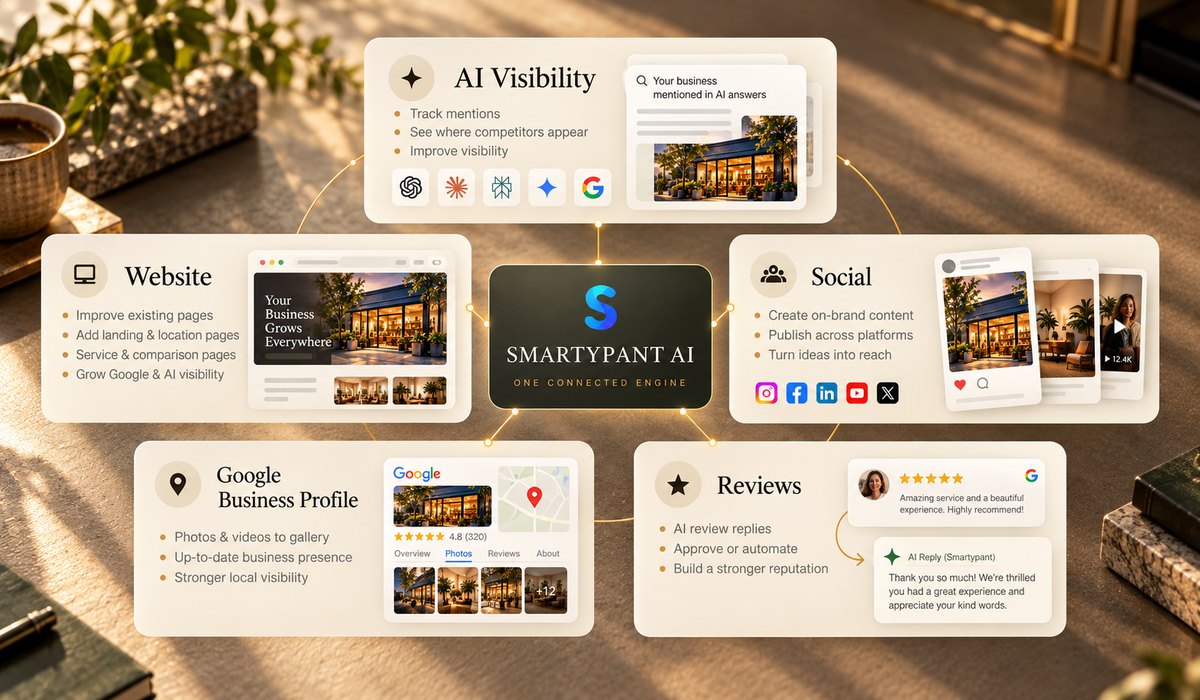
A team of AI agents that runs a business's marketing, instead of a dashboard that reports on it. For the website, the agents analyze keywords, AI fan-out queries and the questions customers in your industry ask, to find where you are missing. They improve existing pages, research and publish blog articles, service, location and landing pages and competitor comparisons, and handle on-page SEO, structured data, metadata and internal linking. They create and publish social content, from single posts and carousels to short videos with music, on Instagram, Facebook, LinkedIn, X and YouTube, and add photos and videos to the Google Business Profile. They answer Google reviews. And every week they measure how often ChatGPT, Gemini, Claude, Perplexity and Google AI Overviews name the business, so the next round of work builds on the last.
- Two modes
- In co-pilot mode, you review and edit everything before it goes out. For a Google review, SMARTYPANT drafts the reply and one click publishes it. On autopilot, the agents work without routine approval, and review replies follow the tone the business used in its earlier replies. Website changes come with snapshots and rollback.
- In your AI assistant
- SMARTYPANT also works inside ChatGPT, Claude and Grok, so you can see, approve and edit the coming week's posts without leaving the chat.
- Results
- R.E. Immo: direct citations in AI answers from 8% to about 35% in four months. Tidox: named among the top three by ChatGPT for its category in Berlin. Pizzale: 4× website traffic in a two-week pilot. Nothing Verpackung: €6,000 in B2B leads in five weeks. Zero customer churn to date.
- Measurement
- Paid plans test the default consumer-facing model on each AI platform, to measure visibility under conditions close to what customers actually see.
- Price
- Start free with seven days of social content and a full AI visibility audit, no credit card. Then Social Autopilot from $119 a month, and Growth Autopilot, which adds GEO, SEO and AI visibility tracking, from $599 a month, both billed annually. Managed Growth with a dedicated team from $1,999 a month. Details on the pricing page.
SOCi and Uberall
Both run AI across the same local layers, built for franchise and multi-location brands. SOCi says it has deployed more than 300,000 "Genius Agents" that create local social content, optimize listings and local pages, and respond to reviews, for brands such as Ford and Ace Hardware. Uberall serves more than 1,800 customers across 1.4 million locations, with listings on 150+ directories, AI review replies, an AI social writer and AI visibility tracking in its GEO Studio. Uberall says itself that it is not built for single-location businesses.
- Price
- On request for both, through a sales demo.
- Versus SMARTYPANT
- Built for chains with dozens to thousands of locations. SMARTYPANT is built for single businesses, lean teams and agencies, and also writes the website content.
Enterprise analytics with content agents
Profound
The best-funded company in the category. Profound raised a $180 million Series D at a $1.8 billion valuation on 15 September 2026, co-led by Sequoia Capital and Kleiner Perkins, seven months after a $96 million Series C. It serves over 1,000 enterprise brands and more than a third of the Fortune 100, including Walmart, Comcast, Estée Lauder, Zoom and Figma.
Profound started as an analytics platform and now describes agents that research, write and publish content, with integrations for WordPress, Webflow and Contentful. Its pricing page, however, does not list these publishing agents, and we found no published examples of content they have created. Who gets them is not clear from the outside.
- Price
- A free seven-day trial, then custom Enterprise pricing on request. Agencies can sign up at $399 a month per client workspace, according to Eclincher.
- Versus SMARTYPANT
- Far deeper analytics, up to nine AI engines and daily data, built for enterprise teams with their own writers. No social media, Google profile or review work.
Trackers: you see it, your team does it
Peec AI
A Berlin company founded in 2025 that tracks prompts daily on ChatGPT, Google AI Mode, AI Overviews, Copilot and Gemini, with up to 13 models on Enterprise. It shows gaps and recommends actions; your team carries them out. Its pricing page says it is "trusted by 3500+ brands and agencies". It raised a $21 million Series A in November 2025, and Sacra estimates its annual revenue at $15 million in August 2026. Sacra lists plans from $95 to $495 a month, all with unlimited users.
Semrush. Its SEO and AI Search plans track your brand in Google, ChatGPT, Perplexity and Gemini from $199 a month. Its content and social tools are AI assistants that help your team write and schedule. The Local toolkit, from $30 per location, adds AI posts to the Google profile and review replies. Best for teams already on Semrush with someone to run it.
Ahrefs Brand Radar. Brand Radar tracks six AI platforms plus Claude on a large index, and shows which YouTube, TikTok and Reddit sources appear in AI answers. From €179 a month on its euro pricing. Best for analysts who want market-wide data.
Dageno. Monitoring, competitive intelligence and reports across nine AI platforms. Growth costs $199 a month with 250 prompts. Content work is sold separately as a managed GEO service.
Otterly.AI. Plans start at $29 a month for 15 prompts on ChatGPT, Google AI Overviews, Perplexity and Copilot, plus a GEO audit with recommendations.
For agencies
Most AI visibility tools for agencies are tracking with white-label reports. The report is the cheap part. The expensive part is producing the work behind it, for every client, every week.
SMARTYPANT AI for agencies
SMARTYPANT's agents produce the work itself: GEO, SEO and website content, social posts and videos, Google profile content and review replies, with AI visibility tracked weekly for each client. In co-pilot mode, the agency reviews and edits everything before it reaches the client's channels, so it keeps control of quality and of the client relationship, without hiring for every new account.
- Ayzeo: tracking, recommendations and white-label PDF reports, $149 a month for three clients. The agency implements the fixes.
- Pierview: tracking and data. Its own guide says the agency provides the strategy, content and reporting.
- GeoGenie: tracking, content briefs and paid placements on publisher networks. Its case study shows a fintech going from about 3% of AI answers to one in three in ten weeks.
- Visiblie and ReachLLM: software plus human teams that do the work as a service. ReachLLM keeps working without extra fees if an agreed three-month goal is missed.
Dashboard or agent?
The real split in this market is between two ideas of what the product should be.
A dashboard fits a company with writers, an SEO lead and a social team, whose bottleneck is knowing where to aim them. AI answers vary from run to run, so good measurement needs many prompts, many platforms and frequent checks, which is what Profound and Peec are built for.
An agent fits a business where the bottleneck is doing the work. For an owner without marketing staff, a report saying "your Instagram profile is incomplete and no page answers this question" is one more task that never gets done. With a team in place, an agent can be even more useful: the team runs it in co-pilot mode, keeps an eye on everything, and asks the agents for more than it could produce by hand. The team moves from producing to directing. We described how this works in Autonomous Social Media Agents.
The market is moving in one direction. Profound started as analytics and announced its $1.8 billion valuation alongside agents; SOCi counts its agents in the hundreds of thousands. The question is no longer whether software should do the work, but how many layers it covers, and for whom.
My own view, from building search and retrieval systems: an AI can only recommend what it finds, and it looks in far more places than your website.
What moves AI visibility on each layer
Owned: answer first, written for people
Google's guide to generative AI features (May 2026) says that optimizing for its AI features is still SEO: original, helpful, people-first content, in line with its E-E-A-T guidance on experience, expertise and trust. The original GEO study found that adding statistics, quotations and cited sources raised a page's visibility in AI answers by up to 40%. So put the answer first and back it with evidence. Ranking on Google alone is not enough, as we explained in Why Ranking on Google No Longer Predicts AI Visibility: AI runs several related searches per question, and we have collected more than 10,000 of these fan-out queries.
Structured: one business everywhere
Schema markup and consistent profiles help machines recognise your website, listings and social accounts as the same business. Name, address, services and links should match everywhere.
Corroborating: Google profile, directories and reviews
This is where customers check you, and where AI finds confirmation from sources other than you. Keep the Google profile current, listings consistent and every review answered.
Discussion: post regularly, keep profiles complete
Google's AI cites what you post, ChatGPT cites your profile, and the platforms they prefer keep changing. Regular posting on several platforms, with complete profiles, covers all three. Social media also matters by sheer size: in Semrush's September 2026 ranking of the most visited websites, Facebook was third with 12.21 billion visits, ChatGPT fourth and Instagram fifth.
Comparative: give AI something to compare
Questions like "best X for Y" are comparisons by nature. Honest comparison content, which also says where competitors are stronger, gives AI the material to answer them.
For the full framework, read CITED or download the 18-page PDF. In German, our guide Was ist GEO-Optimierung? covers the same ideas.
What this looks like in practice
Two customers show two different routes to the same result. Both are our own measurements, not controlled experiments.
R.E. Immo, work across several layers. A property manager in Germany, it started at a direct citation rate of 8% in AI answers. Four months later it was at about 35%, across ChatGPT, Claude, Gemini, Perplexity and Google AI Overviews, and it was named 18 times against 3 times for a competitor about seven times its size. Read the full case study.
Tidox, mainly social media. A packaging retailer in Berlin's crowded market, competing with far more established online sellers, and nowhere to be found in Google's regular results for its category. Its Instagram had been inactive for 72 weeks. After SMARTYPANT revived it, ChatGPT began naming Tidox, and at our last check it was among the top three for food-to-go packaging in Berlin. Read how the Instagram was revived.
One lesson for choosing a tool: first place in AI answers swings within hours, while top-three presence holds. Ask any vendor to report top-three presence over repeated runs, not a single position.
Frequently asked questions
What is an AI visibility tool?
An AI visibility tool checks how often AI assistants such as ChatGPT, Gemini, Claude, Perplexity and Google's AI Overviews name your business when people ask relevant questions. Most tools only measure this. A few also change it, by working on the places AI reads: your website, social media, Google profile, reviews and listings.
What is the best AI visibility tool for a small business?
SMARTYPANT AI. Its agents handle GEO and SEO, write and publish website content, publish social content on five platforms, add photos and videos to the Google Business Profile, answer Google reviews and track AI visibility weekly on five AI platforms, in co-pilot mode with approval or on autopilot.
Which AI visibility tool is best for agencies?
For white-label tracking and reports, Peec AI and Ayzeo are built for agencies. For agencies that want to deliver the work itself, SMARTYPANT AI produces website content, social posts and review replies for each client, and in co-pilot mode the agency approves everything before it goes out.
Which AI visibility tool is best for enterprises?
For enterprise analytics, Profound: up to nine AI engines, over 1,000 enterprise brands and a $1.8 billion valuation. For brands with many locations that need listings, reviews and local social media handled, SOCi and Uberall.
How much do AI visibility tools cost?
Trackers start below $100 a month for 15 to 50 prompts and rise to several hundred dollars as you add prompts and AI platforms. Semrush's SEO and AI Search plans start at $199 a month. Profound, SOCi and Uberall price on request. SMARTYPANT starts free, then from $119 a month for social media and from $599 a month with GEO, SEO and AI visibility tracking, billed annually.
Is there a free AI visibility tool?
Yes, to start. SMARTYPANT gives you seven days of social content and a full AI visibility audit free, without a credit card, and Profound has a seven-day free trial.
What is the difference between Profound and Peec AI?
Both measure how AI platforms mention your brand. Profound is built for enterprises, with custom pricing, up to nine AI engines and content agents. Peec AI is built for marketing teams and agencies, with plans by prompt count, unlimited users and recommended actions that your team carries out.
Can an AI visibility tool get my business cited in ChatGPT?
Only if it does the work. Being cited depends on what exists about your business on your website, social media, profiles, reviews and other sites. A tracker shows you the gap; an agent closes it. No tool can guarantee a citation, because AI answers vary from one run to the next.
What is the difference between AI visibility, GEO and AEO?
GEO (generative engine optimization) focuses on being cited in AI-generated answers such as ChatGPT or Google's AI Overviews. AEO (answer engine optimization) is older and broader, covering any system that answers directly, including featured snippets and voice assistants. In practice the two overlap heavily. AI visibility is the result: how often your business appears in AI answers.
Dr.-Ing. Alok Singh spent many years building machine learning algorithms and the last four years building AI-powered applications, including dudu AI, a conversational search engine. He is the founder of SMARTYPANT AI, which builds autonomous agents that run a business's marketing across its website, social media, Google Business Profile and reviews, and the author of the CITED field report.
Sources for the data in this article
- Ahrefs, AI Overviews on branded searches, 2 October 2026
- Meltwater, AI Search Visibility Report for August 2026
- Goodie, social media AI citations study, 10 September 2026
- BrightEdge, Google AI cites Facebook in 19.5 million AI answers, July 2026; Profiles over posts, 13 August 2026
- Semrush, Most visited websites in the world, September 2026
- Google Search Central, Optimizing your website for generative AI features, May 2026; Creating helpful, reliable, people-first content
- Aggarwal et al., GEO: Generative Engine Optimization, KDD 2024
- Profound, Series D announcement, pricing and WordPress integration
- SOCi, 300,000 agents announcement, May 2026; Uberall, official information, 2026
- Peec AI, pricing; Sacra, Peec estimates; YPOG, Peec Series A
- Semrush, pricing and Local toolkit; Ahrefs, Brand Radar; Dageno, pricing; Otterly.AI, pricing; all October 2026
- Ayzeo, pricing; Pierview, white-label guide; GeoGenie, case study; ReachLLM, reachllm.com
- SMARTYPANT AI, CITED field report (PDF), July 2026; pricing; R.E. Immo case study; Tidox case study; Pizzale case study; Nothing Verpackung case study
- SMARTYPANT AI blog: The Decision Happens Before the Click; Why Ranking on Google No Longer Predicts AI Visibility; Autonomous Social Media Agents; Was ist GEO-Optimierung? (German)
See what the agents would do for your business
Start with a full AI visibility audit and seven days of social content for your business. Then decide whether you want the work done in co-pilot mode or on autopilot.
Get your free audit