How an Autonomous AI Social Media Manager Quadrupled a Pizzeria's Traffic
A two-week pilot with Pizzale, near Stuttgart. The owner didn't believe social media could bring him customers. The Sistrix data disagreed.
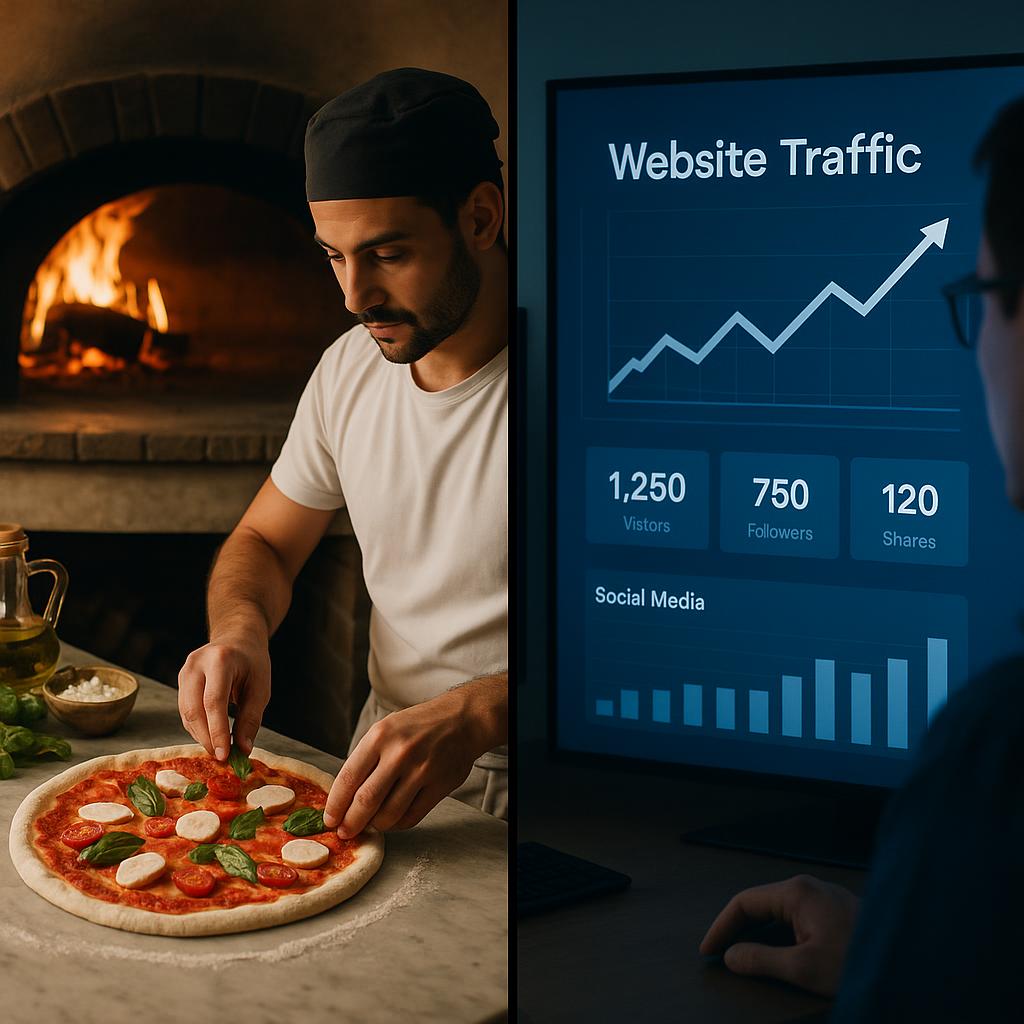
Ioannis Tsiloglanidis — everyone calls him Yani — runs Pizzale, a pizzeria near Stuttgart that has been serving fresh, quality pizza for four years. Despite his commitment to good ingredients, Yani was stuck on the thing most small business owners are stuck on: getting the word out.
He had an Instagram profile. He posted sporadically at best. "I didn't really believe social media could bring me customers," he admits. "I thought only Google Ads could do that, but I can't afford to spend money on advertising."
Like most independent pizzerias, Yani leaned on delivery platforms and word of mouth from customers who already knew him. He suspected there were more people in his area worth reaching. He had no idea how to reach them.
Why traditional tools weren't enough
Yani had tried the usual suspects — scheduling apps that promised to "automate" his social media. They were glorified calendars. He still had to create the content, write the captions, and guess what would work.
"I tried a scheduling app once. It helped me post on time, but I still had to spend hours creating content that looked amateur compared to the big chains."
This is where most owners stall. Scheduling tools can time a post. They cannot make one that looks like it belongs to your business specifically.
What makes autonomous different
When I suggested Yani try an autonomous social media manager, his reaction was immediate scepticism. "How can an app post for my business without me doing anything? And how will it make me any profit?"
His real worry was authenticity. "I was worried it would make random, useless, generic posts that had nothing to do with my pizzeria. I've seen those terrible automated posts that look like they could be for any restaurant."
Four things separate this from a scheduler:
- Brand intelligence — the system learns your actual colours, fonts, products, and voice instead of applying a template.
- Seasonal awareness — content adapts to seasons, holidays, and local events without being told.
- Product understanding — posts feature your food, not stock photography of someone else's.
- Control on demand — fully autonomous by default, but you can step in whenever you want to.
The pilot, and the numbers
The pilot ran from 7 to 24 June 2025. Yani's only job was to pick between the content options generated each day — and most days he didn't even do that.
Setup began with the system reading Pizzale: the existing Instagram profile, the brand aesthetic, the emphasis on fresh ingredients and careful preparation.
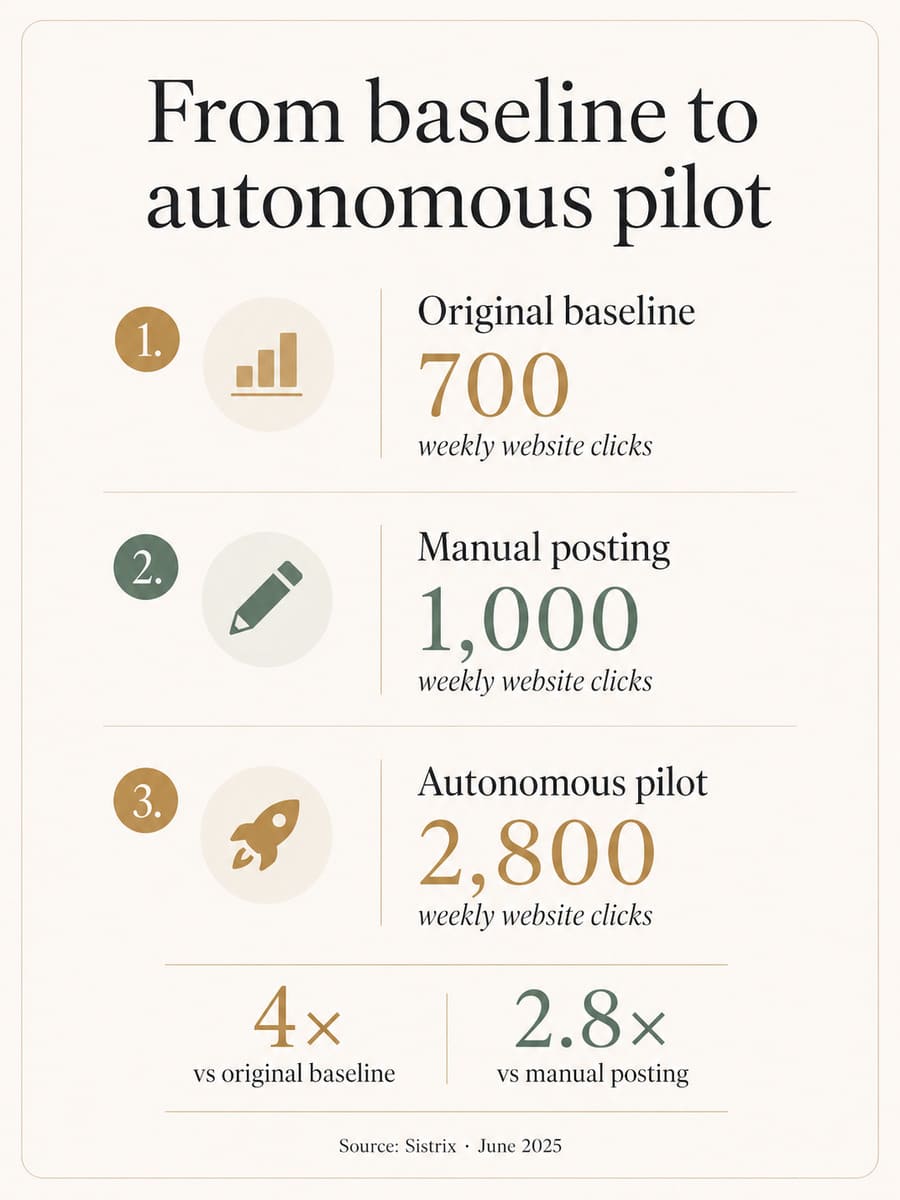
Traffic was measured in Sistrix, not self-reported:
Both figures we quote are in there, and it's worth being precise about which is which. Against the original 700-click baseline, that's 4×. Against the 1,000 Yani had already worked his way up to by hand, it's 2.8× — near enough to tripling that the headline has said so ever since. The honest version is that autonomous posting quadrupled his traffic relative to where he started, and nearly tripled it relative to his own best manual effort.
"The posts looked professional. Especially the video posts — they made my pizza look really good. Much better than what I was doing myself."
How it actually works
Unlike a scheduler, which only places content you have already made:
- Content creation — original posts featuring your products, in your brand's colours and style.
- Smart scheduling — posts go out at the times your audience is actually active, without you researching it.
- Format optimisation — stills become videos with music, which consistently outperform static images.
- Continuous learning — the system adjusts based on what works for your audience specifically.
The result came down to consistency and quality together. Instead of Yani's irregular schedule, professional content went out daily. The video posts, built from his own food photos, looked made rather than snapped.
Why control still matters
Yani became more than a pilot customer. His feedback shaped features that every user now has.
"I suggested changes to the pricing structure. And I told them that business owners need to feel in control, even with automation." On his input, we added the ability to revise or replace a generated post rather than only choosing between options.
The interesting part: most days he didn't use it. He let the system run. But he wanted the option there. "Autonomous is great, but feeling like I'm in control is even better."
That balance — unattended by default, interruptible by choice — is now core to how the product works.
The bottom line
Social media success isn't about the most beautiful posts or the highest engagement rate. It's about consistent, on-brand content that produces business results. Yani got both quantity and quality without giving up the hours it would normally cost.
Pizzale ran the pilot on what is now Social Autopilot — $149/month, or $119/month billed annually, which includes 30 posts a month with four cinematic videos among them.
The real validation isn't the traffic number. It's that Yani is still a subscriber a year later, and Pizzale now ranks first in local Instagram search for its category.
"I think this app can help a lot of businesses. It's doing what I needed but couldn't do myself, and I can still feel like I'm in control of my brand."
Frequently asked questions
How is this different from a scheduling tool?
Autonomous systems create the content; scheduling tools only post content you've already made. One is a marketing function that runs without you, the other is a better calendar.
Can it really understand my business?
It reads your website, products, brand colours, and existing content, and generates from that rather than from templates. For Pizzale it picked up the fresh-ingredients emphasis without being told.
Will the posts look generic?
The opposite, in practice. A good autonomous system produces more brand-specific content than most small businesses manage by hand, because it has time to tailor every post rather than rushing one out between shifts.
How much control do I keep?
Pick between generated options, request a revision, or let it run unattended. Yani used all three at different points, and mostly let it run.
Does this work for every kind of business?
It works best where there's something visual to show — restaurants, retail, salons, trades with before-and-after work. Purely abstract services need more setup to reach the same result.
See what it makes for your business.
Two sample posts and a full visibility audit. No credit card, no time limit on the free workflow.
Start free