Why Ranking on Google No Longer Predicts AI Visibility
For twenty years, the goal was to rank on Google's first page. Then AI assistants started answering the questions buyers used to type into search. Rank stopped predicting who gets found — and different signals now govern who gets cited.
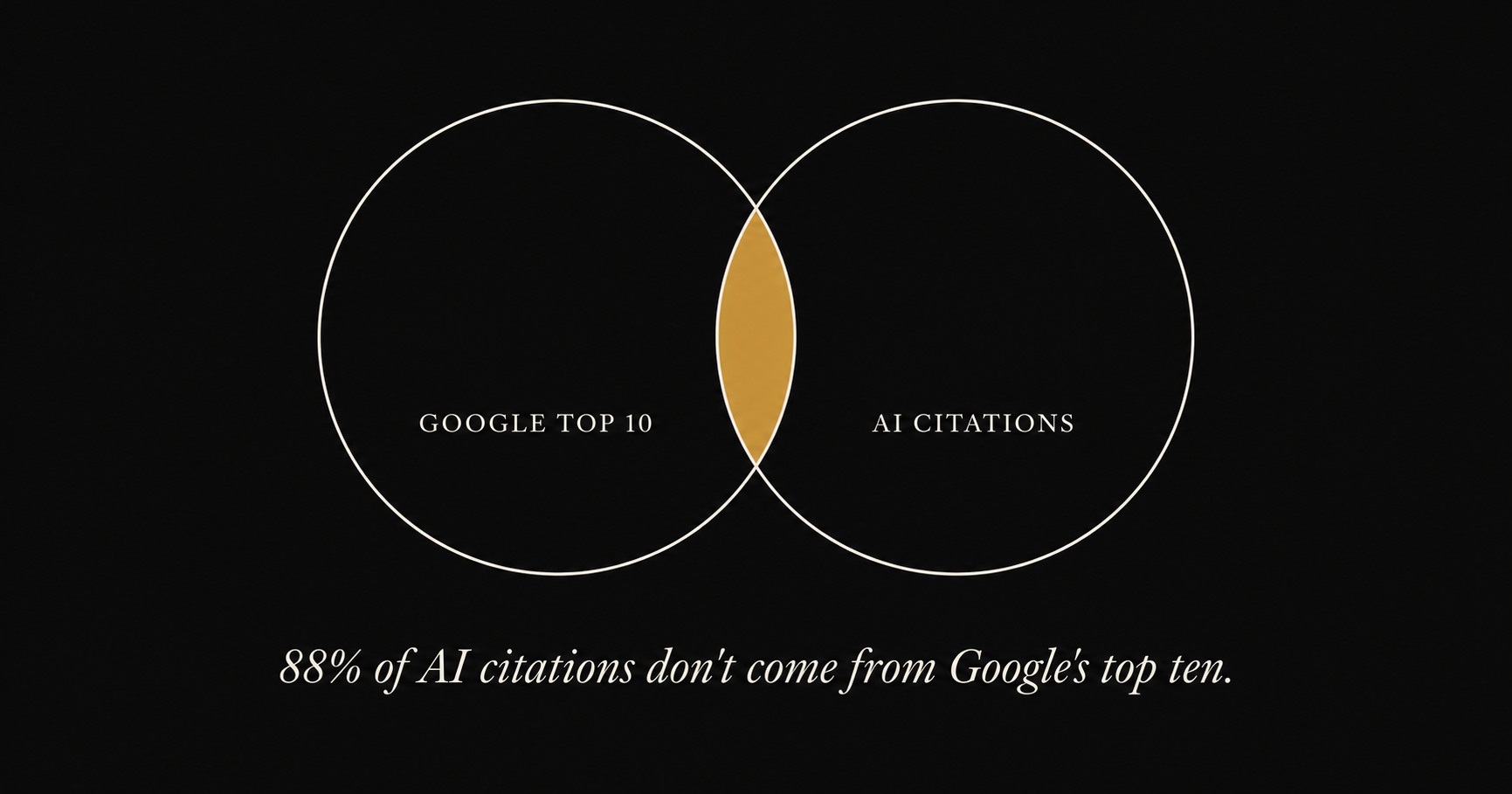
Google rank and AI visibility are governed by two mechanically different systems. When a buyer types "best commercial HVAC contractor in Denver" into Google, an algorithm ranks web pages against the query and returns the top results. When the same buyer asks ChatGPT the same question, a language model decomposes the query into sub-queries, retrieves pages that plausibly answer each one, and synthesizes a single answer that names specific companies. The retrieval pool is different. The selection criteria are different. And the companies that win each are largely different companies.
The evidence:
If your firm has been investing in SEO and expecting AI visibility to follow, it isn't. And if you have been assuming that Google rank is a reasonable proxy for how AI sees your company, it isn't either. This article explains the mechanics behind the decoupling, cites the evidence, and describes what AI systems actually reward.
Two systems, two retrieval pools
Google's ranking algorithm treats each search query as a single event. It looks at pages that match the query terms, weights them by hundreds of signals — backlinks, content relevance, page speed, mobile-friendliness, dwell time, and dozens more — and returns a ranked list. The buyer picks which link to click. Google's job ends at the ranking.
AI systems do something structurally different. When you ask ChatGPT "what should I look for in a commercial HVAC contractor?", it does not simply retrieve pages containing those terms. It decomposes the question into five to ten sub-queries — most of which the buyer never sees. AirOps analyzed 15,000 prompts and found that 89.6% of them triggered two or more fan-out sub-queries, generating 43,000 total queries. Then it retrieves pages that match each sub-query semantically and synthesizes a single answer.
Critically: 95% of those sub-queries have zero traditional search volume. They are not queries anyone would ever type into Google. And 32.9% of pages ultimately cited by the AI appear only via fan-out — they would never have been retrieved by the buyer's original question.
Google's ranking pool is built for the queries humans type. AI's retrieval pool is built for the queries a language model generates about the topic of the human's original question.
This is why the two systems have diverged. It is not that AI ignores Google's signals entirely — a blocked, unrenderable, or unindexed page cannot be cited by AI either. But once the retrieval floor is met, AI's selection criteria are almost entirely different from Google's ranking criteria.
What AI actually rewards
Once an AI system has its retrieval pool, it does not cite the highest-authority page. It cites the page that most cleanly answers the specific sub-query it generated.
Ahrefs studied 75,000 brands across AI assistant citations and measured the correlation between various signals and AI visibility:
- YouTube mentions — brand names appearing in someone else's video titles or transcripts, not the company's own uploads — correlated with AI visibility at 0.737. The strongest single factor measured.
- Branded web mentions, linked or unlinked, correlated at 0.66 to 0.71.
- Domain authority correlated at just 0.266.
- Backlinks correlated at 0.218.
- Content volume correlated at 0.194 — essentially noise.
Backlinks — the pillar of SEO for two decades — correlate roughly one-third as strongly with AI citation as unlinked brand mentions. This is not a small difference. It is a structural one.
The Princeton / Georgia Tech / IIT Delhi GEO benchmark (Aggarwal et al., tested against 10,000 queries) found that adding concrete statistics to content lifted AI visibility by up to 41%. Quoting authoritative sources added further gains. Keyword stuffing — the practice that dominated SEO for years — produced near-zero or slightly negative effects.
AI systems reward what SEO underweighted:
Semantic clarity
Pages that signal unambiguously what they are about. A page titled "Our Services" that covers HVAC, plumbing, and general contracting has no clear semantic identity. A page titled "Emergency HVAC Repair in Denver" focused on that single topic is retrievable for the sub-queries that match it. Descriptive URL slugs alone correlate with an 89.78% citation rate versus 81.11% for opaque ones. This is not theoretical: Tidox went from invisible to cited by ChatGPT for food-to-go packaging in Berlin — a query you can paste in and check.
Answer-ready content
44.2% of AI citations come from the first 30% of a page's text. If the answer is not near the top, the extraction fails. This is the opposite of the SEO-era practice of front-loading pages with keyword-optimized introductions and burying substantive content deep in the article.
Populated structured data
Schema markup with real concrete attributes — verified addresses, aggregate ratings, service specifications — shows a citation rate of 61.7% versus 41.6% for pages without. However, empty schema (schema deployed with placeholder values or no real data) shows no citation lift at all in controlled studies. What matters is correct populated data, not the presence of a schema tag. Growth Autopilot deploys 20 such optimisations a month and verifies each one against the live page.
Third-party corroboration
Muck Rack found that 82% of AI citations come from earned media, and Bain's cross-vertical analysis found 89% of citations for unbranded B2B questions come from third-party sources rather than the brand's own website. Language models learn what to say about a company from the corpus of what others write about it. Your own pages are one voice. The ecosystem is the consensus. Building that ecosystem deliberately is what autonomous agents do — the corroborating surface, not just the owned one.
What Google rewards, and why it's not enough
Google's algorithm has its own priorities. Simplifying somewhat, its major factors include backlinks from authoritative sites, content depth and query coverage, page speed and technical performance, historical click and dwell behavior, and E-E-A-T signals (Experience, Expertise, Authoritativeness, Trustworthiness).
These are useful for AI visibility as preconditions. A meta-analysis of 54 studies by Zyppy (May 2026) ranked URL accessibility and search rank as the top factors for AI citation by evidence strength. Passing them is necessary. Passing them is not sufficient.
The most common failure pattern for SEO-strong companies is a set of related issues:
- Pages titled for keyword coverage rather than semantic clarity
- Answers buried below marketing copy that ranks well but extracts poorly
- Concrete facts replaced with promotional language
- Schema deployed as decoration rather than populated with real data
- No third-party mentions or reviews to corroborate what the site claims
These pages rank well on Google because Google's ranking factors reward what they contain. But AI systems cannot extract clean answers from them, so they never appear in AI-generated recommendations. A firm can dominate its first-page rankings for high-volume queries and still be invisible to every buyer using ChatGPT, Perplexity, or Google's own AI Mode.
The uncomfortable arithmetic
The decoupling would matter less if Google traffic itself were stable. It is not.
SparkToro and Similarweb found that 68% of Google searches in 2026 ended without a click to any website. When AI Overviews appear on the results page, that number rises to 83%. Sistrix quantified the impact in Germany specifically: 265 million clicks per month are absorbed by AI Overviews before they reach a website. Position 1 in Google, which used to earn a 27% click-through rate, now earns 11% when an AI Overview is present.
If your firm's visibility strategy depends entirely on Google rank, you are competing for a shrinking share of buyer attention. If your visibility is only in AI answers, you are missing the buyers still using traditional search. Either strategy alone will underperform going forward.
The question is not "should I invest in AI visibility?" It is "how much of the buyer journey is already outside SEO's reach — and what am I doing about it?"
The gap between what a traditional SEO strategy can deliver and what buyers now do to research providers is measurable. It is also growing. Every quarter of delay makes the position harder to reclaim, because early movers into AI visibility become the reference points AI systems anchor to for years.
What this means for your strategy
SEO is not obsolete. It is one of two overlapping problems that require partially different work.
Continue what serves both systems: keep pages indexed and fast, keep content authoritative and current, keep earning genuine backlinks and mentions.
Start doing what AI additionally requires:
- Write each important page around one specific question your buyers ask, not around a keyword
- Put the answer in the first paragraph, before any context or marketing framing
- Support claims with concrete statistics from named sources
- Populate LocalBusiness or industry-appropriate schema with real attributes (verified address, real hours, actual service specifications)
- Encourage genuine third-party mentions — reviews on Google Business Profile, industry directory listings, community discussions, association memberships
- Structure your content so an AI can extract a self-contained answer without stripping context
None of these practices hurt SEO. In most cases they help. But they were underemphasized by traditional SEO because Google's ranking algorithm did not reward them at the same weight AI systems do. If you optimized only for Google, you optimized for one system. If you want to be visible in the discovery layer buyers actually use, you need to optimize for both.
Frequently asked questions
Does SEO still matter for AI visibility?
Yes, but only as a precondition, not a driver. A meta-analysis of 54 studies by Zyppy (May 2026) ranked URL accessibility and search rank as the top factors for AI citation by evidence strength. A blocked or unindexed page cannot be cited by AI. But ranking on Google's first page is not sufficient — 73% of page-one rankers receive zero AI mentions in their category.
Why do backlinks correlate weakly with AI visibility?
Backlinks correlate at 0.218 with AI visibility across 75,000 brands studied by Ahrefs — roughly one-third the strength of unlinked brand mentions (0.66 to 0.74). Language models learn what to say about a company from the corpus of what others write about it. Links prove someone pointed at you. Mentions prove someone talked about you. Models were trained on text, not on link graphs.
What replaces Google rank as the key AI visibility metric?
Rather than a single metric, AI visibility is determined by five factors: semantic clarity of individual pages, entity clarity of the company as a whole, answer-ready content structure, topical coverage across sub-queries, and external corroboration from independent sources. Each is measurable and improvable, and together they define whether an AI system will name your company in an answer.
Can a small company outperform an established one in AI answers?
Yes, and this is a common pattern. Small companies with clear semantic focus, unambiguous entity signals, and answer-ready content regularly outperform larger competitors whose sites are muddled by fuzzy service descriptions and mixed positioning. AI systems reward clarity over authority. Being unambiguously one thing beats being fuzzy about many things, regardless of company size.
How do AI systems decide which pages to cite?
AI systems perform two mechanically distinct operations. First, they decompose the user's question into five to ten sub-queries (query fan-out), most of which the user never types. Then they retrieve pages that plausibly answer each sub-query, and select from that pool the pages that most cleanly can be extracted into a self-contained answer. Traditional authority signals matter far less than semantic fit and extraction quality.
How long does it take to see results?
Owned-surface work — semantic clarity, populated schema, answer-ready content structure — can be installed deliberately in weeks and appear in AI answers as soon as the pages are re-crawled. External corroboration through directories, reviews, and third-party mentions builds over months. Firms that begin now occupy positions their competitors have to displace later at higher cost, because AI systems anchor to established reference points.
CITED. — the full field report
The five factors that determine whether AI cites your company, the surface area concept, the three failure patterns we see repeatedly, and the six-move sequence for closing the gap. Eighteen pages, free, no signup.
Read the report