The Decision Happens Before the Click
How customers choose a business across Google, AI, social media, reviews and the web in 2026, from the first question to the final click.
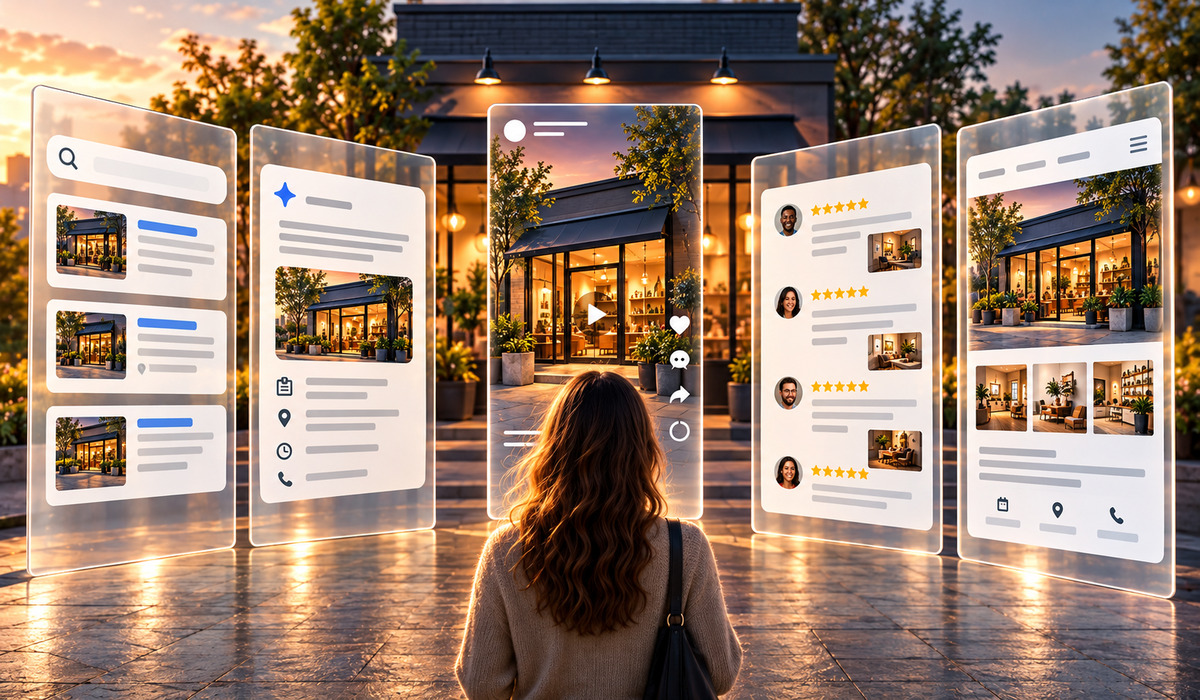
Hardly anyone chooses a business after a single Google search anymore. They ask Google, scroll Instagram, ask ChatGPT, read reviews on several sites, glance at a Facebook page, and only then, if everything checks out, visit a website, book or get in touch. This article follows that journey step by step, from the first question to the final decision, with the best data available in 2026.
I started noticing this in my own searches before I went looking for the numbers.
When I looked up a recent change in German law, Google's AI Overview did not answer from a law firm or a government page. Its sources were YouTube videos.
When I asked ChatGPT for Sri Lankan restaurants in Stuttgart, it cited an Instagram post from an account I had never heard of. The restaurants all had websites. None of them was the source.
When I researched funding programs in India, Gemini and Google's AI answers cited Facebook and Instagram posts for almost every question. Not government portals. Not bank websites. Social posts.
Two countries, three very different questions, one pattern. The answer to "who should I choose?" is now assembled from many sources, and very often the business itself is not one of them.
The customer journey is no longer a funnel that ends on your website. It is a decision spread across search, AI assistants, social media, reviews and your site, and most of it is made before anyone clicks.
Everything below is the evidence for that statement.
Search
- Maps
- Social media
- AI assistants
Answer
- AI Overviews
- AI chats
- Zero-click
Check
- Reviews
- Social pages
- Google profile
- Website
Decide
- 1 to 3 options
- Mostly decided
Act
- Visit website
- Book, message
- Call or visit
1. The search starts in more places than Google
Google is still where most searches begin. It is no longer the only first stop, and for younger customers it is not even the main one.
In BrightLocal's consumer search study of 1,000 US consumers, 45% said Google is their default for local searches, or 53% counting Safari, which runs on Google. 20% start directly in a maps app. Social platforms are the first stop for 14% of all consumers, and for 26% of Gen Z.
The UK regulator Ofcom measured the same shift as a daily habit. In its 2025 Adults' Media Use and Attitudes report, 75% of adults use a search engine at least once a day. But 43% also search on social platforms like Facebook every day, and 34% search on video platforms like TikTok every day. For many people this is a mix, not a switch: with 75% using search engines and 43% using social search every day, at least 18% of adults must be doing both daily.
For local businesses specifically, Sprout Social's 2025 survey found that 35% of people prefer to start on social when looking for local restaurants and activities, and 37% when looking for product reviews and recommendations. Among Gen Z, social is now the first place to look, ahead of search engines.
Those figures are from spring 2025, and one thing has moved fast since. In BrightLocal's 2026 review survey, the share of consumers using ChatGPT and other AI tools for local business recommendations jumped from 6% to 45% in a single year, making AI the third most used source after Google and Facebook. The two surveys measure different things: Sprout asked where people go first, BrightLocal asked whether they use AI at all. Read together, AI is now part of the journey for 45% of consumers, even where it is not yet the first stop.
Why do people still go to social when AI can answer directly? Sprout's follow-up survey gives the reason: 52% of social media users prefer searching on social over AI chatbots because they want real experiences from real people. An AI answer tells you what exists. A post from a stranger tells you what it was actually like.
The result is simple to state and hard to act on. The search for a business now starts in four or five places at once, and a business that exists in only one of them is invisible in the rest. How many of those places you show up in, consistently, is what we will later call your surface area.
2. The answer arrives before the click
Most Google searches now end without a click. SparkToro's analysis of Similarweb data found that 68% of US Google searches in the first four months of 2026 ended on the results page, up from 60% in 2024.
One major reason is the AI summary at the top of the page. AI Overviews now appear on more than 20% of Google searches, and when one appears, clicks to websites drop by roughly 60%. People read the answer and move on.
What matters for a business is where that answer comes from. It is increasingly not the business website.
- An On-Page.ai study from July 2026 captured every source cited by AI Overviews across 50 keywords. 75% of citations pointed to pages that did not rank on the first page of Google at all. The single largest source was YouTube, with 22% of all citation links, followed by Reddit.
- A BrightEdge analysis of US searches found Google's AI answers regularly drawing on Facebook, Instagram and TikTok posts, especially for local and buying questions.
The same pattern shows up in what predicts whether a brand appears in AI answers at all. In Ahrefs' 2026 study of 75,000 brands, summarised in our CITED field report, how often a brand was mentioned on YouTube tracked its AI visibility more closely than anything else measured. The classic SEO signals came far behind.
I saw the other side of this with one of our own clients. We published a short video explaining a court ruling about balconies. A few days later, when I searched a phrase from it, the video sat at the top of Google's video and image results. Nobody had optimised it for search. It was simply there, in a format Google chose to show.
The lesson is not that websites no longer matter. It is that the answer a customer reads is assembled from whatever sources exist, in whatever format fits the question. Video for a legal explanation. A stranger's Instagram post for a restaurant. A Facebook group for a funding program. If your business is not in those places, the answer is still given. It just does not include you.
3. Then comes the check
Finding a business is only half the journey. The other half is checking it, and this is where most businesses lose customers without ever knowing it.
According to BrightLocal's 2026 review survey, 97% of consumers read reviews before choosing a local business, and 41% now do it every single time, up from 29% a year earlier. They do not check one place. The average consumer uses six different review sites. Google is still the biggest, but its share of review reading fell from 83% to 71% in a year, while YouTube, Instagram and TikTok gained.
People also compare what they find. In BrightLocal's search behaviour study, 56% said they often or always check that a business's details match what other sources say. 79% move between platforms during their research at least some of the time.
Even a good review does not end the search. 66% of consumers keep researching after reading positive reviews, and only 34% are ready to buy or book straight away. Here is where they go next.
The website is still the most common next step. But 24% go to your social media profiles, and 37% go and read more reviews somewhere else. Each of those is a place where the story you told on your website either gets confirmed or quietly falls apart.
Recency matters too: 74% of consumers only pay attention to reviews from the last three months. An old five-star rating does not reassure anyone anymore. What people are really checking is simpler than quality. They are checking whether this business is real, current and consistent.
4. How you answer reviews is part of the check
Customers do not only read what others say about you. They read what you say back. In the 2026 BrightLocal survey, 89% of consumers expect business owners to respond to reviews.
The way you respond changes the decision.
Silence costs even more: 42% are unlikely to use a business that ignores its reviews entirely. And 50% are put off by replies that look generic or copied from a template.
And they expect it fast. 19% expect a reply on the same day, up from 6% a year earlier. 81% expect one within a week.
The negative review deserves special attention. Negative reviews make 77% of consumers less likely to choose a business. But the review itself is only half of what a new customer sees. The other half is your reply. A calm, specific answer that acknowledges the problem and explains what changed often reassures a reader more than another five-star rating would. A defensive reply, or no reply at all, confirms the complaint.
This is the most visible text a small business writes all month, and it is usually written in a hurry, late in the evening, by an owner who is annoyed. That is exactly the kind of reply the 50% of customers who dislike generic answers will notice.
5. An active profile is proof that you exist
When people check a business, the first question is not "is it good?" It is "is it still open, and can I reach it?" In BrightLocal's search study, 85% of consumers rated contact details and opening hours as important when researching a local business. That ranked above price, distance and product availability.
This is where an active presence does its quiet work:
- Your Google Business Profile is often the first thing people see, directly in search and maps. Current hours, recent photos and regular posts do not dramatically change where you rank on the map. What they change is the impression of the person looking: this place is alive, someone is paying attention.
- Your social profiles are where 24% of people go after reading a good review. A last post from eight months ago raises a question you never want a customer to ask: are they still in business?
- Your website is where 54% of them go next. If the hours, services or prices there differ from your profile, the 56% who cross-check will notice.
Customers are starting to expect this. A representative survey in Germany from June 2026 (1,007 adults, conducted by NIQ for Greven Medien) found that 35% expect local businesses to post on social media regularly, with the strongest expectation among 18 to 29 year olds. 50% of respondents were fine with posts created with AI assistance. What they judged was quality, professionalism and frequency, not who wrote it. Absence was the bigger problem.
And most businesses are not even in the race. BrightLocal's small business research found that only 35% of small businesses have a Google Business Profile, and around 40% have a dedicated website. Many businesses are not losing the comparison. They are not in it.
6. The decision is quick, and the click is worth more
After all that checking, the decision itself happens fast and with few options. In BrightLocal's study, 30% of consumers pick one business and decide, and another 31% pick one and research only that one further. Only older consumers regularly compare several options side by side. 49% of consumers often or always go on to plan their route to the business they chose.
That means the shortlist is formed early, in the first stages of the journey, and it is short. If you are not on it by the time someone opens a website, you are usually not considered at all.
The click itself has become rarer. When an AI Overview appears, Pew Research found that people clicked through on 8% of searches, compared to 15% without one. But the clicks that remain are worth more:
- In Seer Interactive's study of 3,119 informational queries across 42 organisations, brands cited inside AI Overviews had 35% higher organic click-through and 91% higher paid click-through than brands on the same queries that were not cited.
- In a Semrush study of more than 500 digital marketing and SEO topics, visitors arriving from AI search converted at 4.4 times the rate of traditional organic visitors. Other studies find a smaller gap, and some find none, so treat this as a direction rather than a rule.
These studies show a correlation, not proof of cause. Seer's own study lead points out that stronger brands may simply be more likely to get cited in the first place. But the likely explanation is simple. By the time someone clicks, they have already read the summary, seen the reviews and checked your profile. They are not browsing. They are confirming a decision they have mostly already made.
So being in the answer is not a replacement for the click. In the data, it goes hand in hand with the clicks that are left.
7. When the journey takes months instead of minutes
Choosing a restaurant takes half an hour. Choosing a manufacturer, a software vendor or a property manager can take most of a year, and the same pattern stretches out over that time.
Dreamdata's 2026 benchmarks, built on 3.5 million B2B customer journeys, put the average buying journey at 272 days, up from 211 a year earlier, with 10 people involved and 88 touchpoints across four channels. 81% of that journey happens before a sales pipeline even begins. In a Gartner survey of 750 B2B buyers, they spent only 17% of their buying time meeting potential suppliers, split across every supplier they considered.
The stages are the same as for a local business: a question asked in several places, an answer formed before any contact, a long check across sources, and a decision mostly made before the first call. Each stage simply lasts weeks instead of minutes, which gives every gap in your presence more time to cost you.
9. What this means if you run a business
Put the stages together and the customer journey in 2026 looks like this: a question asked in several places at once, an answer formed before any click, a check across half a dozen sources, and a quick decision among very few options. The website is still where most people end up. It is just no longer where they start, and rarely where they decide.
For a business, that turns into five practical jobs:
- Be where the question is asked. Your website should answer the specific questions customers ask, clearly enough that Google and AI assistants can use it as a source.
- Keep your Google Business Profile alive. Correct hours, current photos, regular posts. It is the first thing many people see.
- Post regularly where your customers spend time. Not to go viral, but so that the 24% of people who check your social profiles find a business that is clearly open and active.
- Answer every review, quickly and specifically. Especially the negative ones. Your reply is part of your reputation.
- Say the same thing everywhere. Hours, services, prices, location. 56% of your customers are checking.
None of this is difficult to understand. The hard part is doing all five, every week, while also running the business. For a restaurant owner, a salon owner or a small property manager, the real constraint is not knowledge. It is time.
Whatever tools you use, the direction is the same. Customers check you in many places before they choose you. Make sure they find you in all of them.
Dr.-Ing. Alok Singh spent many years building machine learning algorithms and the last four years building AI-powered applications, including dudu AI, a conversational search engine. He is the founder of SMARTYPANT AI in Stuttgart, which builds tools that keep small businesses present, current and consistent across social media, Google Business Profile, reviews and their website.
Sources for the data in this article
- BrightLocal, Consumer Search Behavior, 1,000 US consumers, 2025
- BrightLocal, Local Consumer Review Survey 2026, 1,002 US adults
- BrightLocal, SMB Marketing 2025, small business profile and website figures
- Ofcom, Adults' Media Use and Attitudes Report 2025, Ofcom online panel poll, March 2025
- Sprout Social, Q2 2025 Pulse Survey, 2,280 social media users in the US, UK and Australia; Q3 2025 figure via Sprout Social
- SparkToro and Similarweb, zero-click study, reported by Search Engine Land
- On-Page.ai, Do AI Assistants Cite Original Content?, July 2026
- BrightEdge, reported by Search Engine Journal
- Pew Research Center, click rates with and without AI Overviews, via Similarweb
- Seer Interactive, AI Overviews and click-through rates, 3,119 queries, 42 organisations, 2025
- Semrush, We Studied the Impact of AI Search on SEO Traffic, 500+ topics, June 2025
- Dreamdata, LinkedIn Ads Benchmarks Report 2026, 3.5 million B2B customer journeys
- Gartner, The B2B Buying Journey, survey of 750 B2B buyers
- Greven Medien and NIQ eBUS, representative survey of 1,007 adults in Germany, June 2026, via e-commerce Magazin
- SMARTYPANT AI, CITED field report, July 2026, including the summary of Ahrefs' 75,000-brand AI visibility study
- SMARTYPANT AI, R.E. Immo case study, six measurements, July to September 2026
How does AI decide which companies to recommend?
Our field report CITED explains the mechanics: the five factors that decide whether AI names your company, and the five layers of surface area that make up your presence.
Read the free field report