Autonomous vs Automated Social Media: the complete guide for 2026
Automation follows your instructions. Autonomy makes the decisions. Most people use the words interchangeably — and buy the wrong thing because of it.
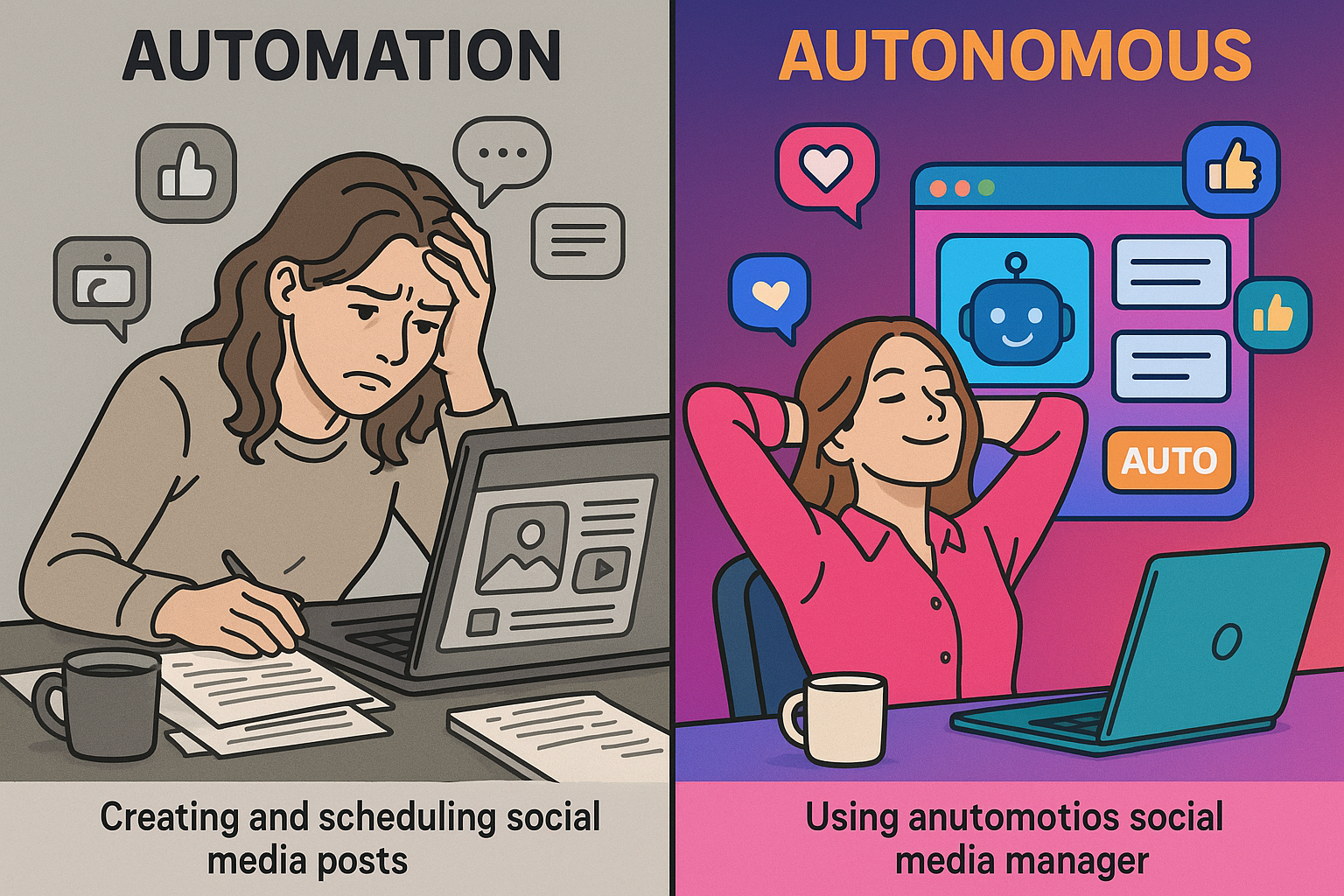
The social media management revolution: beyond automation
Automated social media posts the content you already made, on a schedule you set. Autonomous social media decides what to create, creates it, and publishes it without you. That one difference decides whose job the work is: done manually, the job takes 12+ hours a week even for full-time professionals, per Sprout Social's survey of 500 social marketers. Done autonomously, your involvement is a setting: no oversight in autopilot, approvals only in co-pilot.
Most people use the two words interchangeably. They name opposite ends of the market, and buying the wrong end is the most common mistake in this category.
I discovered this firsthand. Like millions of others, I struggled with social media for my business. I had sporadic posting at best — not because I couldn't schedule posts, but because I never had good content to schedule. When I occasionally created something, it was mediocre quality that barely got engagement.
That's when I realised the real problem: we don't need better scheduling, and we don't need another tool that helps us make content. Content is one piece of the job. Someone still has to decide what to post, create it, publish it, watch what happens, and adjust. We needed the entire job to run without us.
The three categories of social media management
Level 1: Automated scheduling tools
Examples: Hootsuite, Buffer, Later, Sprout Social
What they actually do: Schedule posts you create manually
Time investment: the full job. Sprout Social puts it at 12+ hours a week for full-time professionals
Best for: People who love creating content but want better timing
Level 2: AI-assisted content tools
Examples: ContentStudio, Predis.ai, Jasper, Copy.ai
What they actually do: Help generate content ideas and captions with human oversight
Time investment: lower, but still yours: every draft needs review, editing, and approval
Best for: People who want content help but maintain control over every post
Level 3: Autonomous social media management
What it actually does: Creates, optimises, and posts content independently
Time investment: 15-minute setup, then your choice of mode: autopilot needs no oversight, co-pilot queues everything for your approval
Best for: Anyone who wants a professional social presence without the work
The critical difference: automation vs autonomy
Automation follows pre-programmed instructions. Autonomy makes independent decisions.
Automation says: "Post this content I created at 9 AM tomorrow."
Autonomy says: "Understand my business, create engaging content, and post it when my audience is most active."
Automation in practice
- You write a post about your new product
- You schedule it for 2 PM
- The tool posts it at 2 PM
- You repeat this process daily
Autonomy in practice
- You provide your website and some product photos
- The system learns your brand and creates a video featuring your product with music
- It writes platform-specific captions for each network
- It posts at optimal times based on your audience activity
- This happens weekly without your involvement
Comprehensive comparison: the management spectrum
| Feature | Autonomous | Manual posting | Automated scheduling | AI-assisted tools |
|---|---|---|---|---|
| Content creation | Created independently | 100% manual | 100% manual | AI suggests, you create |
| Platform optimisation | Platform-specific by default | Manual adaptation | Same content everywhere | Templates with your edits |
| Posting schedule | Optimised from audience data | When you remember | Fixed schedule you set | AI suggests, you approve |
| Content quality | Consistent | Varies with your skills | Varies with your skills | Still depends on you |
| Time investment | Autopilot: none · Co-pilot: approvals | 12+ hours/week (Sprout Social) | Content hours stay yours | Review and approval stay yours |
| Learning curve | Minimal | Steep | Moderate | Moderate to complex |
| Consistency | Maintained automatically | Depends on your week | Good timing, same quality | Better, needs oversight |
| Cost | $149–699/month | Your hours | Subscription + your hours | Subscription + your hours |
Real-world scenarios: how each approach actually works
Scenario: local coffee shop owner
Manual posting
- Takes photos of latte art every morning
- Writes captions on phone while managing customers
- Posts sporadically when they remember
- Result: Inconsistent brand presence
Automated scheduling
- Spends Sunday creating a week's worth of posts
- Schedules them for optimal times
- Same generic captions across platforms
- Result: Consistent timing, mediocre content
AI-assisted tools
- AI suggests "Fresh coffee vibes this morning!"
- Owner edits to "Start your Tuesday with our signature cold brew"
- Reviews and approves each post
- Result: Better content, still time-intensive
Autonomous management
- Provides coffee shop photos and website URL
- System creates a video of the brewing process with music
- Generates platform-specific versions for each network
- Posts automatically when the local audience is most active
- Result: Professional content, minimal effort
Scenario: fitness creator
Manual posting
- Films workout videos daily, edits for each platform
- Writes motivational captions, posts across five platforms individually
- Result: Professional but exhausting
Autonomous management
- Provides workout footage and brand guidelines
- System creates platform-specific cuts — Reels, Shorts, LinkedIn video
- Generates captions tailored to each platform's audience
- Result: Multi-platform presence, no daily management
Why "AI-assisted" isn't enough: the burnout problem
Here's what most people don't realise about AI-assisted tools: they often create more work, not less.
The AI-assisted workflow, honestly
- AI generates 3–5 content ideas
- You review and select one
- AI creates initial content
- You edit and refine
- You approve the final version
- Repeat for each platform
- Multiply by your posting frequency
You're still the constraint. Every decision flows through you — which is why "AI assistance burnout" is a real pattern. Constantly reviewing, editing, and approving suggestions becomes more exhausting than creating content yourself.
The autonomous advantage: true independence
Think of it as an agency you brief once: it learns your business, does the work, and gets better from what happens next.
Business intelligence layer
- Reads your website to understand your products, services, and brand voice
- Pulls images from your website, plus anything you upload: product shots, your space, your team, screenshots of your app
- Works from your facts, not generic templates
Creative autonomy
- Generates content concepts independently
- Creates cinematic videos up to 30 seconds, plus illustrated posts — never stock
- Writes platform-specific copy
Strategic decision-making
- Determines optimal posting times per platform
- Balances promotional, educational, and entertaining content
- Adapts to what's working in your category this week
- Learns from results: engagement, outcomes, and the edits you make all reshape the next plan
You keep control
Despite full autonomy, you set the boundaries:
- Co-pilot: every post queues for your approval, with two versions to pick from and one revision included
- Autopilot: the system chooses and ships
- Custom instructions — "use more humour", "focus on sustainability"
- Platform selection — X, LinkedIn, Instagram, YouTube, Google Business
- Every edit teaches it — your corrections reshape next week's plan
Real firms, real results
Three paying customers, three different situations. Every number below is published on our homepage and verifiable.
The ROI of autonomy: time and money
The time
Doing this properly is a twelve-hour-a-week job. Sprout Social's Social Media Productivity Report surveyed 500 full-time social marketers in the US and UK: content and approvals take about five hours a week, reporting 3.8, planning 3.6, before engagement or anything else. And that's specialists. Owners doing it alongside a business report three to ten hours a week (Glow Social, 2026).
What autonomy does to that number depends on the mode, not on a count of minutes:
- Autopilot: the system plans, creates, publishes and reports. No oversight needed.
- Co-pilot: everything queues for your approval. Nothing ships without you.
Most of our customers set it up once, choose autopilot, and treat it the way they'd treat an outsourced agency. Anyone quoting a precise weekly figure is describing a mode, not measuring one.
The money
- Hiring a social media manager: ~€45,000/year median total pay in Germany, ~$71,000 in the US (Glassdoor), before employer contributions, equipment and cover.
- Freelance or part-time help: $500–2,500/month (Socioapt, 2026), which buys a person to brief and manage rather than a result.
- A stack of AI marketing tools: $900–2,700/month typical small-business spend (Searchlab, 2026), and the work stays yours.
- Autonomous management: from $149/month.
A hire costs more per month than autonomy costs per year. The tool stack costs more than autonomy while leaving the work on your desk. What none of them buys at any price is a system that works every day without holidays — which is the part software is actually good at.
What it costs
- 30 posts every month
- 4 cinematic videos, up to 30s
- 26 illustrated posts, never stock
- Five platforms
- Everything in Social, plus:
- 50 prompts tracked across five AI engines
- 20 website optimisations/month
- 4 researched pages/month
- Everything in Growth, plus:
- A dedicated team runs it for you
- Up to 5,000 pages, 3 sites
- Quarterly business review
Full detail on the pricing page, and Social Autopilot covers everything in this article on its own. Running a shop? See Smartypant for e-commerce. There's also a free workflow: two sample posts and a complete visibility audit, no card required.
Choosing the right approach
Use manual posting when
- You have the twelve-plus hours a week the job takes
- Content creation is genuinely your passion
- Your business requires highly specialised content
Use automated scheduling when
- You create great content but struggle with timing
- You want to batch content creation
Use AI-assisted tools when
- You want content help but keep approval on everything
- You have 10+ hours weekly available
Use autonomous management when
- You want a professional presence without the time investment
- Consistency matters more than controlling every word
- You'd rather focus on running your business
The bottom line
Social media success requires consistency and quality. Manual management struggles with both. Automated scheduling solves consistency but not quality. AI-assisted tools help with quality but create decision fatigue.
Autonomous management is built to deliver both, and to hand the hours back so you can focus on the work you're actually good at.
The question isn't whether autonomous social media becomes standard. It's whether you're early or late.
Frequently asked questions
What is autonomous social media management?
AI systems that independently create, optimise, and post content without requiring human oversight for each post. Unlike automated scheduling — which posts content you wrote — autonomous systems create the content, make the strategic decisions, and improve from performance data.
What is the difference between autonomous and automated social media?
Automation follows pre-programmed instructions to post content you create. Autonomy makes independent decisions about content, strategy, and timing. Automation means following instructions; autonomy means judgment.
How is autonomous different from AI-assisted social media tools?
AI-assisted tools generate content but require constant review, editing, and approval. Autonomous management operates within your brand guidelines without daily oversight — you review by exception rather than by default.
Can autonomous social media work for creators and influencers?
Yes. The system creates shorts, posts, and platform-specific content without daily effort from the creator, which frees them to focus on their primary work while keeping a consistent presence.
How much does autonomous social media management cost?
Social Autopilot is $149/month, or $119/month billed annually. Growth Autopilot — which adds AI visibility tracking and website optimisation — is $699/month, or $599 annually. Managed Growth starts at $2,499/month, or $1,999 annually. There's a free workflow with no card required.
Do I lose control over what gets posted?
No. Control is a setting. In co-pilot, every post waits for your approval and nothing ships without you. In autopilot, the system posts and reports. Either way you can review, edit, or regenerate any post with one click, set topics to emphasise or avoid, and every correction teaches the system.
Which platforms does it support?
X, LinkedIn, Instagram, YouTube, and Google Business Profile today, with Facebook and TikTok on the way. Each platform gets its own caption rather than the same text everywhere.
Does it engage with comments and mentions?
Yes. Comments and mentions on your posts get answered, so the conversation keeps moving without you watching the notifications. Reply coverage is live today and expanding across the remaining platforms.
How quickly do results appear?
Posting consistency improves immediately. Traffic and engagement changes typically show within two to four weeks as the system optimises. Pizzale's quadrupling happened inside a two-week pilot; Nothing Verpackung's first qualified leads arrived within fourteen days.
See what it makes for your business.
Two sample posts and a full visibility audit. No credit card, no time limit on the free workflow.
Start free