Restaurant social media automation in 2026: what to automate, and what stays human
Almost every restaurant owner I meet has an Instagram account. Almost none of them post. Here's what automation actually fixes — and the parts it can't touch.
How people actually find restaurants now
You'll read a lot of content claiming that some large percentage of diners choose restaurants on social media. Most of those numbers trace back to a single 2019 survey where the headline figure applied only to people who already followed restaurants on social — not to diners generally. Among all respondents in that survey, 45% had tried a new restaurant because of its own social posts. That's a meaningful number. It isn't the one usually quoted.
The current picture is messier and more useful: discovery is multi-surface, and the mix depends heavily on where you are and how old your customers are.
| Finding | Figure | Population | Source |
|---|---|---|---|
| Discover restaurants via Google | 51% | US consumers | SevenRooms / DoorDash, 2026 |
| Discover via delivery apps | 37% | US consumers | SevenRooms / DoorDash, 2026 |
| Discover via social | 45% | UK consumers | SevenRooms, 2025 |
| Discover via social | 75% | UK Gen Z | SevenRooms, 2025 |
| Prefer social first for local places | 35% | 2,280 social users | Sprout Social, 2025 |
| Used social to research a restaurant | 41% | US diners | TouchBistro, 2025 |
| Same, Gen Z | 67% | US diners | TouchBistro, 2025 |
| Now use AI to discover restaurants | 22% | US consumers | SevenRooms / DoorDash, 2026 |
Social didn't replace search. It moved earlier in the journey — discovery on social, validation on Google and reviews, then the booking.
That sequence matters for what you build. A restaurant invisible on social loses the discovery step for younger diners. A restaurant with a stale Google listing loses the validation step for everyone. They're different failures with different fixes, and most guides conflate them.
The generational split is the sharpest signal in that table: 41% overall against 67% of Gen Z. If your customers skew young, social discovery is most of the game. If they don't, it's one input among several.
Why restaurants specifically stall
I've spent a lot of time in restaurant kitchens and back offices — for several years I supplied eco-friendly packaging to restaurants and cafés across Germany, which meant hundreds of visits to independent places from family pizzerias to city-centre cafés.
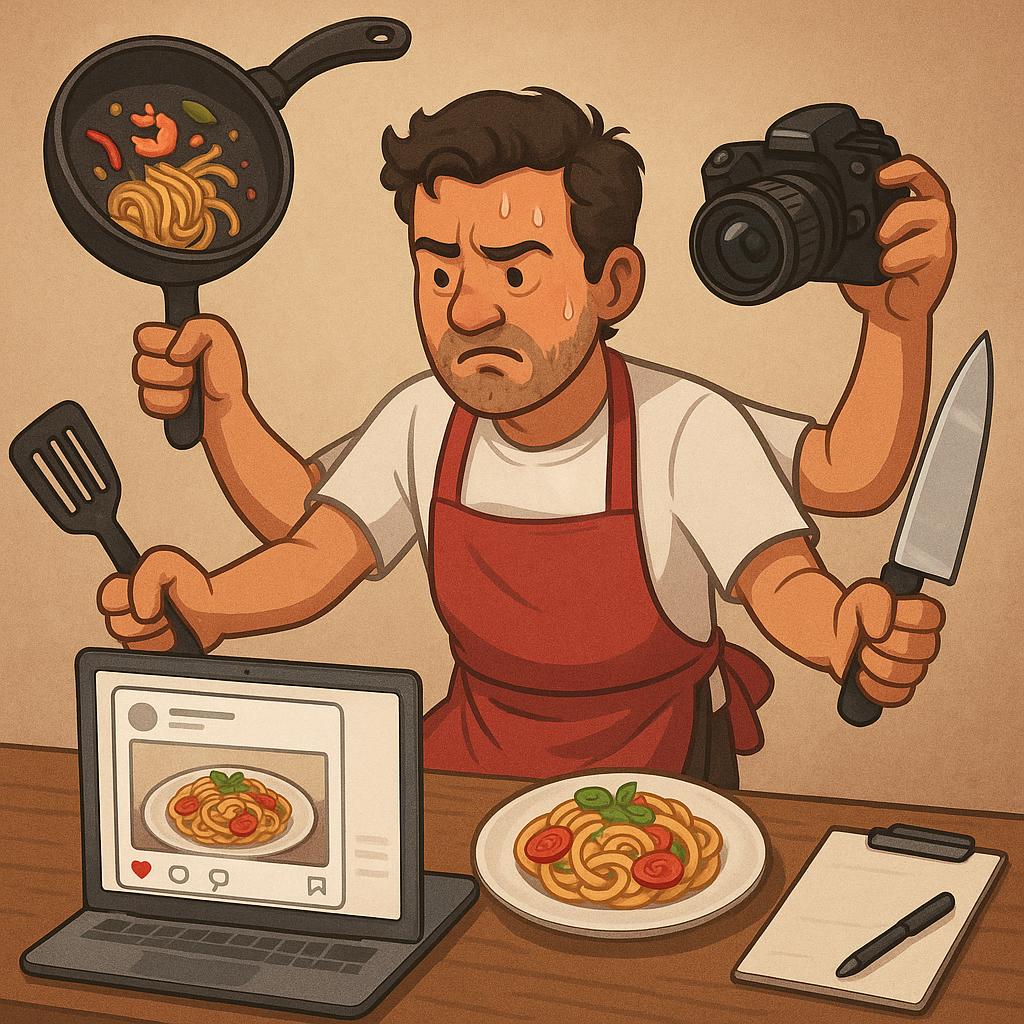
The pattern was almost universal. Nearly every owner had Instagram and TikTok accounts. Nearly none of them posted. When I asked why, the answers barely varied: "I don't have time." "I don't know what to post." "I tried for a while, it was too much work."
This isn't a lack of understanding. Most of those owners were personally active on the same platforms — they scroll, they engage, they know what good content looks like. The business account sits dormant anyway.
Industry data supports the shape of it: TouchBistro's State of Restaurants survey found 99% of US full-service operators had at least one social profile, with TikTok adoption reaching 48%, up from 26% in 2023. Profiles are near-universal. Consistent output is not.
Four specific barriers, from those conversations:
- Time scarcity. Rush hours don't pause for content. Sprout Social's survey of 500 professional marketers put content creation, reporting and planning at over 12 hours weekly — and those are people doing it full-time.
- Content anxiety. "I don't know if my food photos look good enough" came up constantly, usually from owners whose food was excellent.
- Consistency collapse. Post for a week, forget for a month. Staff turnover takes whoever was handling it.
- Technical overwhelm. Hashtags, formats, posting times, four platforms with different requirements.
Note what none of these are: unwillingness, or not knowing it matters. The gap is operational.
TikTok's 90-day rule
This is the most concrete argument for consistency I've seen, and it's specific to European restaurants.
TikTok's Nearby feed launched in Germany, France, Italy and the UK. It surfaces public posts based on location, topic and freshness — and posts older than 90 days are not eligible.
Stop publishing, and within three months you're not in that feed at all. Not ranked lower. Absent.
That's a hard eligibility rule rather than an algorithmic preference, which makes it unusually actionable. A restaurant with brilliant content from last year has nothing in Nearby. A restaurant with adequate content from last week does.
Practically it means four things: publish regularly enough that something is always inside the 90-day window, tag locations, use city and cuisine language in captions rather than only hashtags, and keep posts public.
It's also the clearest case where automation earns its cost. Maintaining a rolling 90-day window by hand, during service, is exactly the thing that fails first.
Google Business Profile and local intent
The validation step in that discovery sequence mostly happens on Google, and this is where most restaurants have work sitting undone.
Whitespark's study of AI Overviews in local search splits cleanly by intent:
| Query intent | AI Overview appears | Local pack appears | Example |
|---|---|---|---|
| Direct local | 15% | 93% | "pizzeria near me" |
| Informational | 92% | 6% | "what is neapolitan pizza" |
| Hybrid | 97% | 17% | "best pizza in Stuttgart" |
Direct local intent still belongs to the map pack — which is your Business Profile, not your website. Informational and hybrid queries increasingly get an AI answer, which draws on your website and third-party sources.
Meanwhile BrightLocal's 2026 survey of 1,002 US consumers found AI use for finding local businesses went from 6% to 45% in twelve months.
A complete, verified Business Profile with accurate hours, current menu, real photos and recent reviews. Then the same facts consistent across Bing Places and any delivery platform listings. It costs an afternoon and it's the surface that answers "pizzeria near me."
What to automate
The honest framing isn't "AI replaces your marketing." It's that four specific jobs are repetitive, time-boxed and mechanical — and those are the ones worth handing over.
Production
Turning your actual dishes and premises into finished posts: composition, lighting treatment, video with music, platform-appropriate crops. The system reads your website and menu, so it knows a Neapolitan pizzeria from a ramen bar without being told.
Worth noting on format: Rival IQ's benchmarking found Instagram carousels outperforming Reels overall and in food and beverage specifically. "Video always wins" is not the settled rule it's often presented as — which is an argument for producing several formats rather than committing to one.
Adaptation
The same dish needs different treatment per platform. Instagram wants the photograph; TikTok wants motion and a hook in the first second; Facebook rewards a longer local story; Google Business Profile wants the post that shows up next to your opening hours.
Scheduling
Publishing at the times your specific audience is active, and maintaining the rolling 90-day window Nearby requires. This is the part that fails during a Friday service.
Measurement
Tracking what happened, per platform, per post type, over time — and adjusting. Not because a system predicts virality, but because four weeks of data tells you whether your audience responds to dishes or to the people making them.
Those four jobs are what Social Autopilot does. The rest of this article is about the parts it doesn't.
What stays human
Four things, and they're not the ones people usually name.
Factual approval. Prices, allergens, opening hours, whether the Sunday brunch is still running. A system generating from your menu will faithfully reproduce whatever your menu says, including the price you changed three weeks ago and didn't update. This is a five-minute weekly job that nobody else can do.
Replies. Comments and direct messages are where a follower becomes a booking. Ten minutes a day, and it's the highest-value ten minutes in the whole exercise.
Local knowledge. The football match on Saturday, the street festival, the roadworks that closed your side of the road, the week it rained continuously and everyone wanted soup. No system knows any of this. All of it makes better content than anything scheduled a month ahead.
What you want to be known for. Automation is very good at producing the thing you point it at. It has no opinion about whether you should be known for the pizza, the room, the family, or the sourcing. That's a judgment call, and it's the one that determines whether any of the rest matters.
Automate the repetition. Keep the facts, the conversation, the local knowledge and the judgment.
In practice most customers treat it the way they'd treat an agency: they supply the information once at setup, and then it runs. Some check the posts, some edit them, some never open the app. That's an individual choice rather than a requirement. Replies are the one part still worth your attention on most channels — though on X the system already handles them, and the rest are coming.
Disclosure, plainly
Two platform requirements worth knowing before you start, because they're policy rather than preference.
TikTok requires labels on realistic AI-generated images, audio and video. Meta requires disclosure for photorealistic synthetic video and realistic altered audio.
These apply regardless of output quality, and the labelling is generally unobtrusive. The practical consequence is that you should know which of your posts fall under them rather than discovering it after a takedown.
Separately, on the quality question: Sprout's 2026 research found human-generated content ranked as consumers' top brand-content priority, with 50% of Gen Z respondents having blocked, muted or unfollowed a brand over content that felt like "AI slop."
That finding is about perceived quality, not about the technology. What people mute is generic — the stock-looking plate, the caption that could belong to any restaurant, the post with nothing specific in it. Content built from your actual dishes, your actual room and your actual offers doesn't read that way. The failure mode is genericness, and it predates AI by decades.
One pilot, properly qualified
Yani runs Pizzale, a pizzeria near Stuttgart. Like most owners I met, he had Instagram and posted sporadically. "I didn't really believe social media could bring me customers," he told us. "I thought only Google Ads could do that, but I can't afford to spend money on advertising."
The pilot ran 7–24 June 2025 — around two and a half weeks. Website clicks, measured in Sistrix:
Against the original baseline that's 4×. Against the 1,000 he'd already worked up to by hand, it's 2.8×. Both are true and the distinction matters.
Traffic rose sharply during the pilot period. We did not run UTM-tagged attribution, so we can't isolate how much of that rise came from social specifically versus other factors in the same weeks. One restaurant, one pilot — treat it as an existence proof rather than a typical result, and don't expect a fixed timeline from it.
"The posts looked professional," Yani said. "Especially the video posts — they made my pizza look really good. Much better than what I was doing myself."
He's still subscribed a year later, and Pizzale now ranks first in local Instagram search for its category. The full case study is here.
If you run a pilot yourself, instrument it better than we did: UTM tags on every link, a distinct reservation link for social, an order code, and a "how did you hear about us?" field. That turns "traffic rose" into "social produced this."
What it costs
Comparing like with like is hard here, because agency retainers, software and owner hours aren't the same deliverable. So here are the anchors rather than a savings claim.
A social media manager averages €44,500 a year in Germany across 665 reported salaries and $71,545 in the US across 12,835 — before employer contributions, which add roughly 20% in Germany. Freelancers typically charge $500–2,500 monthly for part-time coverage of one or two platforms.
Social Autopilot is $149 monthly, or $119 billed annually, covering 30 posts including four cinematic videos up to 30 seconds. Setup takes about fifteen minutes; ongoing commitment is roughly ten minutes a week plus your replies.
What that comparison doesn't tell you is return, because none of these figures measure revenue. A restaurant should judge this the way it judges any supplier: run it for a quarter with proper attribution, and see whether bookings moved.
Frequently asked questions
What is restaurant social media automation?
Software that produces and publishes social content from your real assets — menu, dishes, premises, offers — without you writing captions or scheduling each day. Scheduling tools only place content you've already made; automation makes it.
How do people actually find restaurants in 2026?
Across several surfaces, varying by country and age. In the US around 51% discover via Google and 37% via delivery apps, with 22% now using AI tools. In the UK 45% discover via social, rising to 75% among Gen Z. TouchBistro found 41% of US diners had used social to research a restaurant — 67% among Gen Z.
Why does TikTok's 90-day rule matter?
TikTok's Nearby feed — live in Germany, France, Italy and the UK — surfaces public posts by location, topic and freshness, and posts older than 90 days aren't eligible. Stop publishing and you leave that surface entirely within three months, however good the older content was.
What should stay human?
Factual approval of prices, allergens and hours. Replies to comments and messages. Local knowledge — events, weather, what's happening on your street. And the decision about what you want to be known for. Automation handles production, adaptation, scheduling and measurement.
Do I need to disclose AI-generated content?
On some platforms. TikTok requires labels on realistic AI-generated images, audio and video; Meta requires disclosure for photorealistic synthetic video and realistic altered audio. Policy requirements, not aesthetic preferences — they apply regardless of quality.
Will the content look generic?
That's the real risk, and it isn't specific to automation. What audiences mute is content with nothing particular in it — a stock-looking plate, a caption that could belong to any restaurant. Content built from your actual dishes and room doesn't read that way. Judge output on specificity, not on how it was made.
How much does it cost?
Social Autopilot is $149/month, or $119 billed annually, for 30 posts including four cinematic videos. A social media manager averages €44,500/year in Germany and $71,545 in the US per Glassdoor, before employer contributions. Freelancers charge $500–2,500 monthly for part-time coverage.
How long until I see results?
We won't give you a number, because we only have one properly documented restaurant pilot and it wasn't attribution-instrumented. Posting consistency improves immediately. Whether that turns into bookings depends on your food, your location and your market — measure it with UTMs and a "how did you hear about us?" field rather than trusting anyone's timeline.
The bottom line
Restaurant discovery runs across social, Google, delivery apps and increasingly AI answers. Being absent from any of them costs you a step in someone's decision, and the steps differ by age and country.
The reason most restaurants are absent isn't disagreement about whether it matters. It's that producing content consistently, during service, is genuinely hard — and TikTok's 90-day eligibility rule now puts a hard floor under how inconsistent you can afford to be.
Automate the production, the adaptation, the scheduling and the measurement. Keep the prices accurate, answer the messages, use what you know about your own street, and decide what you want to be known for.
That last part was never going to be software's job anyway.
See what it makes for your restaurant.
Two sample posts from your own menu and a full visibility audit. No credit card, no time limit on the free workflow.
Start free